Skip to main content
Why focusing on potency alone risks misunderstanding both quality and clinical value
Within medical cannabis, THC is often the first point of reference. It is the most visible metric on a label, the easiest to compare across products, and frequently used as a shorthand for quality. In many cases, higher THC is assumed to indicate a higher-quality product.
However, as the sector continues to mature, that assumption is increasingly being questioned.
A more complex plant
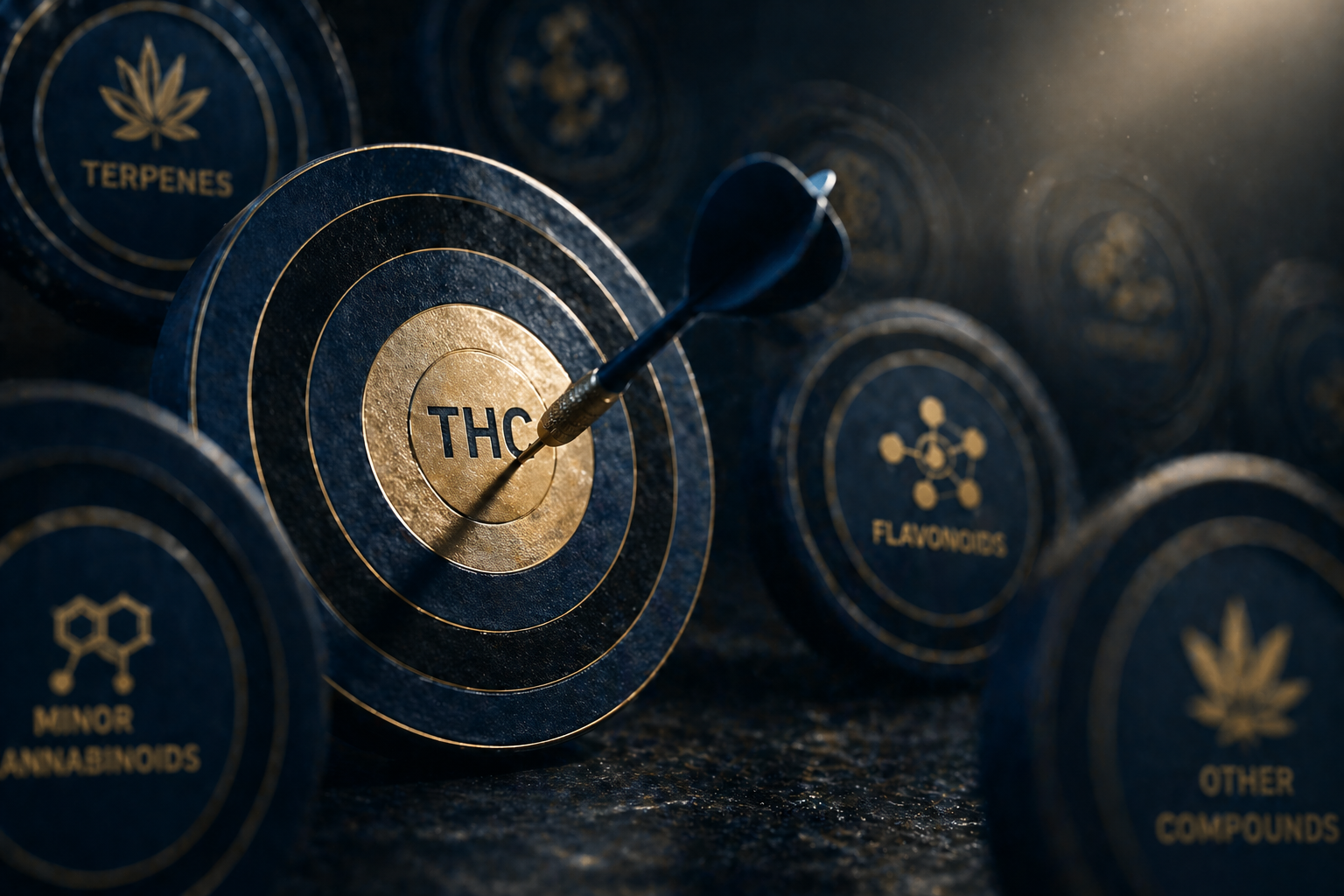
Cannabis is not defined by a single compound.
Alongside THC, the plant contains a range of cannabinoids, terpenes, and other compounds that contribute to its overall chemical profile. Research continues to explore how these elements may interact, often referred to as the entourage effect, although this remains an area of ongoing scientific investigation rather than established clinical consensus.
What is clear is that focusing on THC alone provides only a partial view of the product.
Rethinking “high quality”
The association between higher THC and higher quality is, in part, a product of how cannabis has been evaluated historically.
From a cultivation and manufacturing perspective, quality is more closely linked to consistency, control, and reproducibility. This introduces a less widely understood dynamic.
In regulated markets such as the UK, cannabinoid content must fall within a defined tolerance, typically around ±10% of the stated value on the product label.

While this applies across all products, it has different implications depending on the target potency.
At lower THC levels, the acceptable range becomes narrower in absolute terms. As a result, maintaining consistency within specification requires a higher degree of precision across cultivation, harvesting, and post-processing.
Producing lower-THC flower consistently is not a compromise; it is a reflection of control.
THC, efficacy, and tolerability
In clinical settings, THC is considered through more than one lens. On one hand, it contributes to therapeutic effect for certain patients, with established pharmacological activity across a range of indications. On the other, it is often the factor that limits how much a patient can comfortably use, due to its psychoactive effects.
This creates a balance.
Rather than simply maximising THC, prescribing decisions often involve finding a level that is both effective and well tolerated for the individual patient. In this sense, potency is not just a question of effect, but of usability.
A question of composition
Cannabis flowers produce a finite amount of resin, within which cannabinoids, terpenes, and other compounds are expressed.
This raises an important consideration. If one component is present in higher proportion, what does that mean for the overall composition of the plant?
At present, there is no definitive evidence that increasing THC directly reduces other compounds. However, it is well established that different cultivars express markedly different chemical profiles, shaped by both genetics and environmental conditions.
Research into cannabinoid/terpene interactions suggests that multiple compounds may contribute to overall therapeutic effect, although this remains an evolving area of study rather than settled clinical consensus. What this points to is not a simple hierarchy, but a chemically complex system in which THC is only one part of the picture.

A note on limits
There is also a biological context worth acknowledging.
Studies of commercial cannabis have shown that THC levels in flower tend to fall within a relatively defined range, with observed values typically below the mid-30% range. This suggests there may be practical or biological constraints on how much THC can be expressed in cannabis flower, distinct from processed products such as concentrates.
This does not demonstrate that increasing THC directly reduces terpene content or minor cannabinoids, and it would be inaccurate to claim that it does. However, it does reinforce a broader point; cannabis flower operates within biological limits, and focusing exclusively on maximising THC risks overlooking the broader composition of the plant.
Cannabinoids and terpenes are both produced within the glandular trichomes of the flower, where cannabis resin is formed. This shared origin highlights the complexity of the plant’s chemistry and raises a reasonable question, whether prioritising one component above all others always aligns with maximising the overall value of the medicine.
At present, the exact relationships between these compounds are still being explored.
Beyond a single objective
If the objective were solely to maximise THC, the plant could be bred and selected accordingly. But in a medical context, the objective is different.
It is to produce a product that is:
- consistent
- predictable
- and appropriate for a range of patient needs
This may not always align with maximising a single compound.

Looking ahead
As the medical cannabis sector develops, definitions of quality are likely to evolve.
Greater emphasis is already being placed on:
- batch-to-batch consistency
- clearly characterised chemical profiles
- reliability for both clinicians and patients
Rather than solely on maximising THC content.
The question is not whether THC matters (it clearly does) but whether a single-minded focus on THC risks overlooking the broader composition of the medicine.
Conclusion
A focus on THC alone risks mistaking potency for quality; when in reality, higher levels may reduce how much of a medicine a patient can tolerate and therefore benefit from.
Sources
- Russo, E.B. (2011) – Taming THC: potential cannabis synergy and phytocannabinoid-terpenoid entourage effects
- National Library of Medicine – Reviews on cannabinoid–terpene interactions
- ElSohly et al. (2018) – Changes in Cannabis Potency Over Time (Scientific Reports)
- General literature on cannabis trichome biology and cannabinoid biosynthesis
Photography: Colin Caswell Photography